
Energy update
Energy Update — 26 March 2026
Iran deadline extended to 6 April with the Strait still closed; gas prices stay elevated and the 1 April TNUoS hike compounds the move.
Market Update
Energy costs remain volatile. This morning, President Trump's has again extended his deadline for Iran to agree to re-open the Strait of Hormuz, until 6th April. Failure to do so is set to incur an escalation of bombing of Iranian power and desalination plants, and other key services. In response, Iran has threatened to strike the energy and water infrastructure of Gulf states supporting America. Despite conflicting statements over how urgently Iran is seeking a resolution, talks are reportedly ongoing in Pakistan.
Iran has been presented with a 15-point plan for cessation of hostilities and has responded with new proposals. The US has twice bombed Iran in the last year while negotiating with them, suggesting that talks don’t necessarily mean an end to hostilities. Iran has separately proposed allowing passage through the Strait, conditional on the ships not being from the US or its allies. Further, they submit to Iranian controls and pay a fee for safe passage – the Tehran Tollbooth.
This conflict seems unlikely to be resolved soon, and it will take months for production and distribution facilities to return to their previous levels. Consequently, a shortfall in oil and gas will impact global energy costs, with some research indicating that the UK is likely to be the most affected country economically.
We are less vulnerable than in the energy crisis of 2022. This crisis is expected to have a greater impact on gas than on electricity costs. In the short term, the European energy market seems stable. European & UK gas reserves are at 28 & 36% respectively. The UK only generates around 27% of electricity from gas annually, and has significantly more electricity available from renewable sources, and is able to obtain electricity from French and Danish generation via sub-sea interconnectors. Gas supply will be tight over the summer, though the increasing global supply of LNG over the next 5 years provides longer-term security.
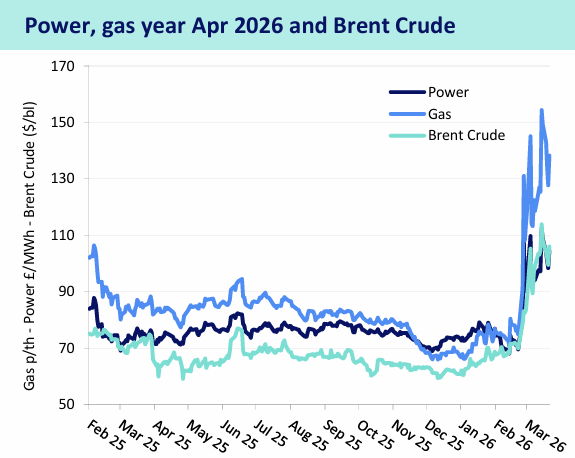
Business Energy Costs
Electricity contract costs have remained stable following the initial spike, while gas contracts increasingly reflect the higher commodity cost. This is understandable given that electricity non-commodity costs comprise about 60% of the costs. These costs are set to rise further on 1st April due to increases in Transmission and other non-commodity charges. Operators should already have been notified by their electricity supplier of the increases in costs, typically ranging from £1 to £9 per day.
| Commodity Cost | Av Unit Rate | Av Standing/Ch | ||
|---|---|---|---|---|
| Electricity | 27/02/2026 | 6.9p | 23.1p | £1.52 |
| 12/03/2026 | 9.6p | 26.5p | £2.00 | |
| 26/03/2026 | 9.6p | 25.9p | £2.11 | |
| Gas | 27/02/2026 | 2.5p | 5.5p | £1.98 |
| 12/03/2026 | 4.2p | 7p | £1.57 | |
| 26/03/2026 | 4.2p | 7.4p | £2.12 |
Current market conditions leave anyone close to their renewal window vulnerable to having to fix on higher costs. However, these costs are nowhere near those at the peak of the previous energy crisis. Some operators, coming out of a 3-year contract, may find that their existing contract rates are broadly in line with those currently available. There is little benefit in moving onto deemed rates to wait for prices to fall, given they are much higher than available contract rates. Cost certainty is the key objective for most customers, who are recommended to:-
- Ensure they get a range of contract offers from different suppliers and contract lengths.
- Understand the key supplier terms and conditions, to be able to assess the best value.
- Avoid quotes being out of date by conducting research in as short a period as possible and choosing promptly.
- If using a broker, ensure they disclose their commission and if they have any penalty clauses if the contract doesn’t go live, or terminates early.
- Don’t be pressured into choosing by claims that you “have to decide today”.
Nationwide Energy works with a wide range of suppliers, whose products are well-suited to the hospitality industry. We provide the necessary information about suppliers' T&Cs, our commission, and the time you need to decide. There are no nasty surprises working with us. We provide ongoing support with any utility issues.
Graph produced by Cornwall Insight in conjunction with Drax Energy Solutions, 26/03/2026.
Other ways we help hospitality operators
Electricity
Compare business electricity contracts and lock in rates.
Gas
Source business gas at competitive rates for your sites.
Insurance
SME business insurance via our preferred broker partner.
EPOS Systems
Reliable EPOS systems to enhance your business operations.
Nationwide Payments
Explore card machines and estimate costs on our Nationwide Payments website.